From Plot to Profit: The Smart Investor's Guide to Pakistani Real Estate
Millions of Pakistanis own plots. Far fewer profit from them the way they should.
The typical story goes like this: a plot is bought with good intentions, held for a few years while "the time is right," and then either sold in a panic during a liquidity crunch or passed down to the next generation still undeveloped. The opportunity that existed on the day of purchase — to build, develop, rent, or sell strategically — quietly evaporates over years of passive waiting.
Owning a plot is a start. Knowing what to do with it is where real investors separate themselves. This guide covers exactly that — the strategic paths from plot to profit, how to choose the right one, and what Pakistan's smartest property investors are doing in 2025 to compound their returns.
Understand What's Actually Driving Your Plot's Value
Before any strategy makes sense, you need to understand the forces currently pushing — or stalling — your plot's value. Not all plots appreciate equally. The ones that compound significantly share specific characteristics:
Infrastructure proximity — Is a new road, interchange, metro station, or commercial hub being developed nearby? Infrastructure reliably pushes surrounding land values up, often before construction even begins. Plots adjacent to the Orange Line in Lahore, the Lahore Ring Road corridor, and smart city development zones in Sargodha all followed this pattern.
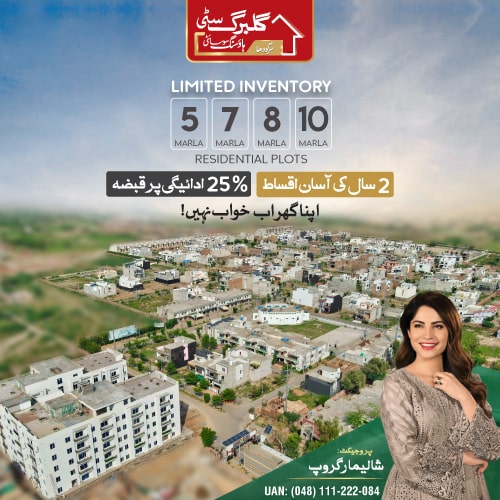
Society maturity — A plot in a society where 60–70% of homes are constructed is worth significantly more than one in a society where most plots are still empty. Occupied communities have functional amenities, established footfall, and proven demand. Gulberg City Sargodha with its operational roads, commercial strip, Grand Jamia Masjid, and parks already sits at a maturity level that gives plot owners a genuine value base to build from.
Commercial designation — A commercially designated plot earns more per square foot than residential, both in rental income and resale value. If your plot sits in or adjacent to a commercial zone, that single factor can transform your profit strategy.
Know your plot's value drivers before choosing your profit path. The strategy follows the asset — not the other way around.
Path 1 — Build to Rent
For investors with a medium to long time horizon, building on a plot to generate rental income is one of Pakistan's most consistent wealth-building strategies.
A well-built multi-floor residential structure on a plot in an established society generates stable monthly income while the underlying land continues to appreciate. The rent covers maintenance, property tax, and mortgage repayments if applicable — with surplus cash flow growing over time as rents escalate.
The key variables that determine whether build-to-rent works:
Rental demand in the area — Are properties actively rented out in this society? What is the average occupancy rate? An area with high vacancy rates will not support the strategy regardless of construction quality Construction cost vs rental yield — Calculate total construction cost per square foot vs projected monthly rent. In most established Pakistani cities, multi-floor residential construction yields 4–6% annually on total investment when professionally managed Floor count — Pakistani plots typically allow G+2 or G+3 construction depending on zoning. Each additional floor multiplies rental income from the same land footprint — the most efficient use of an urban plotFor commercial plots in high-footfall zones — think Shalimar Smart City Sargodha's Business District or established commercial belts — the build-to-rent case is even stronger. Commercial tenants pay higher per-square-foot rents, sign longer leases, and maintain properties better. A commercial building on the right plot can yield 7–9% annually on invested capital.
Path 2 — Develop and Sell
For investors who want capital return rather than ongoing income, developing and then selling can crystallise significant gains in a shorter window.
This path works best when:
The plot is in an early-phase society where land values are still rising rapidly You can add genuine value through construction before the peak of the appreciation curve The exit market is liquid — buyers are actively purchasing in that areaThe key to this strategy is timing the development cycle correctly. Building a house in a society where prices are already at peak adds construction cost without proportionate value gain. Building in a society that's 30–40% developed — occupancy growing, amenities coming online, demand clearly rising — and selling upon completion captures both land appreciation and construction value simultaneously.
Early investors in Shalimar Smart City Sargodha who entered Phase 1 have already seen 40–50% capital gains on their plots before any construction. Those who build during this window and sell at Phase 3 completion pricing will layer construction value on top of that appreciation — a compounded return that passive holding simply cannot match.
Path 3 — Strategic Hold With Active Management
Sometimes the smartest move is to hold — but active holding rather than passive waiting looks very different.
Active holding means:
Monitoring the development curve of your society and setting a clear trigger price or milestone for when you'll act Keeping your plot maintained — a cleared, accessible, well-maintained plot commands higher buyer confidence than one showing neglect Watching adjacent development — when commercial or institutional projects (schools, hospitals, mosques) break ground near your plot, values adjust quickly. Position yourself to act before the adjustment is fully priced in Setting a definitive timeline — passive holders let years slip by indefinitely. Active investors set a 12–24 month decision window: build, develop, or sell at the end of itThe difference between active and passive holding is the difference between a deliberate strategy and an accident waiting to happen.
The Profit Framework: Which Path Fits Your Plot?
| Situation | Best Path |
|---|---|
| Plot in mature society, high rental demand | Build to rent |
| Commercial plot in a business zone | Build commercial, long-term rent |
| Early-phase society, rising appreciation curve | Develop and sell at peak |
| Well-located plot, 12–24 month horizon | Active hold with clear exit trigger |
| Plot in stagnant area with no development signal | Sell now and redeploy capital |
No plot is automatically profitable. Every plot has an optimal strategy — and the cost of choosing the wrong one, or choosing none at all, is measured in years of missed return.
Final Takeaway
The gap between owning a plot and profiting from it is not luck or market timing. It is strategy, information, and the discipline to act. Pakistan's most successful property investors are not passive landholders — they are active decision-makers who understand what drives value, choose the right path for their asset, and execute with conviction.
Your plot is not a waiting room. It is a decision waiting to be made.
What strategy are you currently using for your plot — and has it delivered the returns you expected? Share your experience in the comments below.
Explore verified plot listings, commercial units, and investment opportunities across Pakistan on Jaageer.com — find the right asset for your next move.