The Dream of Owning a Home Just Got Real, But Only If You Act Fast
Let me be straight with you. For most middle and lower-income families in Pakistan, owning a home has felt less like a goal and more like a fantasy. Rising property prices, sky-high markup rates, and zero access to structured financing have kept millions of Pakistanis trapped in rented rooms, paying someone else's mortgage while building no wealth of their own.
That reality is now being challenged directly.
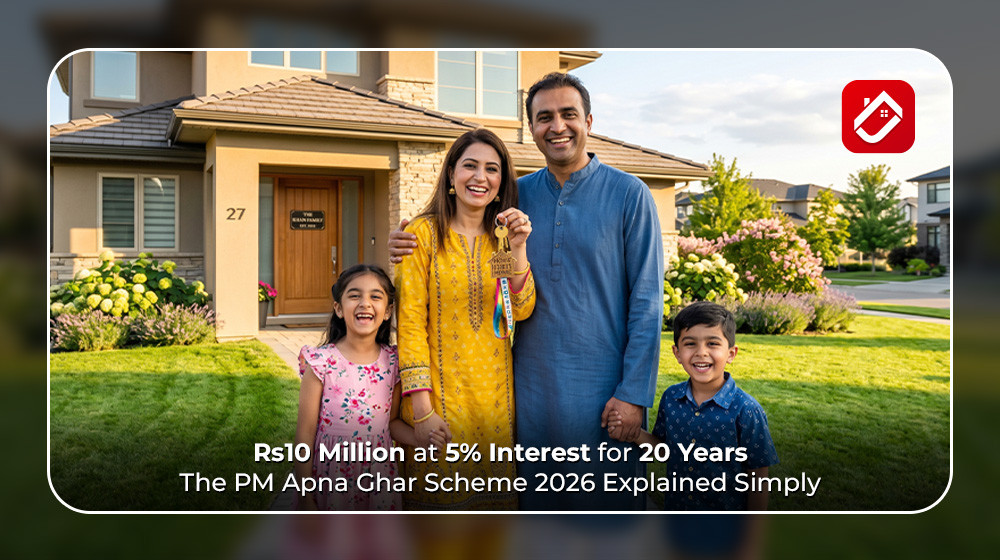
On April 30, 2026, Prime Minister Muhammad Shehbaz Sharif officially launched the Wazir-e-Azam Apna Ghar Program 2026, Pakistan's most ambitious affordable housing initiative in years. With loans of up to Rs10 million at a fixed 5% markup, a 20-year repayment window, and only 10% down payment required, this program is designed specifically for people who thought homeownership simply wasn't possible for them.
But here's the thing, the first-year target is only 50,000 homes. In a country with a housing shortfall of over 10 million units, that window will fill fast.
So let's break down exactly what this scheme offers, who qualifies, and how you can apply before the spots run out.
What Is the Wazir-e-Azam Apna Ghar Program, And Why Does It Matter?
The Apna Ghar Program is not just another government housing announcement. It is a structured, bank-backed, subsidised financing scheme that connects eligible citizens directly to partner financial institutions, with the government absorbing a significant portion of the financial risk on your behalf.
Here's the big picture:
Total target: 500,000 housing units over four years Year 1 target: 50,000 homes financed with Rs321 billion Total allocation: Rs3.2 trillion Coverage: All four provinces, Islamabad, Gilgit-Baltistan, and Azad Jammu & KashmirWhat makes this different from past schemes, like the PTI-era Mera Pakistan Mera Ghar, is the improved financial structure and the direct involvement of both commercial and Islamic banks from day one. The government isn't building the houses. It's financing you to build or buy them yourself, through a transparent, digital application process at apnaghar.gov.pk.
That shift in approach matters enormously. It respects your agency, works through established banking infrastructure, and creates real economic activity in the process.
The Loan Structure, Breaking Down the Numbers You Actually Care About
Let's get into the specifics, because the financial design of this scheme is genuinely one of its strongest features.
Maximum Loan Amount: Rs10 million (Rs1 Crore) Your Contribution (Down Payment): Only 10% of property value Bank Financing: Up to 90%, one of the highest LTV ratios ever offered in Pakistani housing finance Markup Rate (First 10 Years): Fixed at 5%, locked in, regardless of inflation or KIBOR changes Markup Rate (Years 11–20): Shifts to market rate (1-year KIBOR + 3%) Repayment Period: Up to 20 years Processing Fees: Zero Prepayment Penalty: None, pay it off early with no extra cost
To put the 5% rate in perspective, commercial housing loans in Pakistan today typically range between 18% and 22% annually. This scheme cuts your markup by more than 75% for the first decade. For a family financing Rs5 million, that difference in monthly installment is life-changing.
The government also provides 10% risk coverage on the outstanding portfolio on a first-loss basis, meaning if defaults occur at a portfolio level, the government absorbs the first layer of loss. This incentivizes banks to actually lend to lower-income applicants rather than quietly prioritizing high-income, low-risk borrowers, which has historically undermined similar schemes.
Do You Qualify? The Eligibility Criteria Explained Clearly
This is where a lot of applicants get confused, or worse, disqualified after wasting time. Read this section carefully.
You ARE eligible if:
You hold a valid CNIC (Pakistani citizen) or NICOP (overseas Pakistani) You are a first-time homeowner, no residential property registered in your name anywhere in Pakistan Your monthly income is at least Rs25,000 (Rs20,000 for a co-applicant) You are salaried with a minimum of 2 years of employment history You are self-employed with at least 3 years of documented business history You want to build or buy a home up to 10 Marla or a flat up to 1,500–2,000 sq ft You are under 60 years of age at loan maturity (salaried) or 65 years (self-employed)You are NOT eligible if:
You already own any house, flat, or apartment, even a small one, in your name You cannot provide income documentation (salary slips, bank statements, or business proof) You are applying for a property larger than the specified size limits Another member of your household has already availed the scheme, only one loan per householdOne practical tip: If your NADRA records have any inconsistencies, address mismatches, outdated information, resolve those before applying. Verification delays from NADRA are one of the most common reasons for application holdups.
How to Apply, A Step-by-Step Guide
The application process has been designed to be fully digital and corruption-resistant. Here's how it works in practice:
Step 1, Register Online Visit apnaghar.gov.pk and create your account using your CNIC number and registered mobile number. Double-check that your mobile number matches your CNIC record in the NADRA database.
Step 2, Submit Your Documents Once your initial registration is reviewed, shortlisted applicants are directed to partner banks including NBP, Bank of Punjab, Bank AL Habib, Meezan Bank, and MCB Islamic. You will need to provide proof of income, property documents (if building on your own plot), and identification.
Step 3, Bank Verification Your chosen bank will verify documents and conduct a site visit to the property. This step is non-negotiable, do not skip preparing your property documents in advance.
Step 4, Staged Fund Release This is an important distinction from traditional loans. The money is not handed to you in one lump sum. Funds are released in stages, first for the foundation, then the grey structure, then finishing. This ensures the loan is used strictly for construction and protects both you and the bank.
Practical tip: Avoid any agent or middleman who promises to "speed up" your application in exchange for a fee. The process is digital and government-monitored, there are no shortcuts, and you risk losing your eligibility entirely if irregularities are found.
The Bigger Economic Picture, Why This Matters Beyond Your Home
The Apna Ghar Program is not simply a social welfare initiative. It is, by design, an economic multiplier.
The construction of 500,000 housing units activates more than 40 allied industries, cement, steel, timber, bricks, electrical fittings, plumbing, interior design, and logistics. Every home built under this scheme generates demand across the entire supply chain, creating employment for labourers, engineers, architects, and small business owners at every level.
When you pair this with Punjab's Stamp Duty Amendment Ordinance 2026, which cut rural property transfer costs from 3% to 1% and introduced the legal assignable deed, you begin to see a coordinated government strategy taking shape:
Federal level: Subsidised financing to make buying affordable Provincial level: Reduced transaction costs to make transferring cheaper Combined effect: A genuine, structured attempt to bring millions of Pakistanis into formal homeownershipPakistan's mortgage-to-GDP ratio currently sits below 0.5%. Malaysia's is 44%. The gap represents not just a social failure, it represents an enormous untapped economic opportunity. If even a fraction of Pakistan's rental-paying population converts to formal mortgage holders, the downstream effect on the banking sector, construction industry, and national GDP would be substantial.
What the Critics Are Saying, A Balanced View
No serious analysis of this scheme would be complete without acknowledging the legitimate concerns.
Pakistan's housing shortage is growing by 400,000 units per year. Even if the Apna Ghar Program hits every target, 50,000 homes in year one covers roughly one-eighth of the annual shortfall, let alone the existing backlog of 10 million units.
There are also unanswered structural questions: Where will the land come from at scale? How will Rs3.2 trillion be mobilised without creating IMF complications? And critically, will banks actually lend to lower-income first-time buyers, or quietly redirect approvals to the safer, higher-income applicants that protect their portfolios?
These are fair questions. But they are not reasons to dismiss the scheme. They are reasons to hold the government accountable to its implementation commitments, particularly the PM's stated pledge to personally review progress every single month.
The scheme's direction is right. The financial structure is genuinely innovative. Whether it delivers depends entirely on execution.
Conclusion: Is This Your Moment?
If you are a Pakistani citizen earning Rs25,000 or more, do not own a home, and have been waiting for a realistic path to homeownership, this program may be the clearest opportunity you will see in this decade.
The financial terms are exceptional by any standard. The application process is digital and accessible. The banks are on board. The government has committed real money at real scale.
But first-year slots are limited to 50,000 homes. In a country of 240 million people, with millions of first-time buyers, that window is narrow.
The best time to apply was yesterday. The second best time is today.
Visit apnaghar.gov.pk, check your eligibility, prepare your documents, and take the first step toward saying, finally, Ghar Ho Tu Apna.
Are you planning to apply for the Apna Ghar Program? What's the biggest challenge holding you back, eligibility, documentation, or finding the right property? Share your thoughts below.