Choosing the Perfect Commercial Location in Pakistan: A Practical Guide
In residential property, a bad location is an inconvenience. In commercial property, a bad location is a business death sentence.
A shop in the wrong street sits empty for months between tenants. A food outlet positioned one block away from actual foot traffic never reaches breakeven. An office floor in a building no one can easily reach stays vacant despite competitive pricing. The price you paid becomes irrelevant when nobody shows up.
This is why commercial location selection is the most consequential decision in the entire investment process — and why most Pakistani investors spend more time evaluating the property itself than the location it sits in. This guide corrects that imbalance with a practical, street-level framework for choosing commercial locations that work.
Understand What Type of Commercial Demand You're Serving
Not all commercial locations succeed for the same reasons. Before evaluating any site, identify which demand category your property serves — because the location criteria are completely different for each.
Retail and foot traffic-dependent businesses — shops, restaurants, pharmacies, salons. These need dense residential population within walking distance, high pedestrian movement, and street-level visibility. MM Alam Road in Lahore works because thousands of people pass through daily. A commercial plot three streets back from that same road captures almost none of that demand.
Professional and office uses — medical practices, law firms, accounting offices, corporate tenants. These need accessibility, parking, prestige address, and proximity to complementary services. Blue Area Islamabad and Gulberg Lahore anchor this category because they've become the default address for professional services.
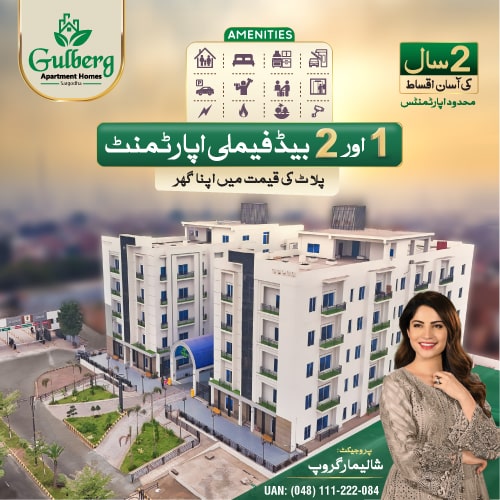
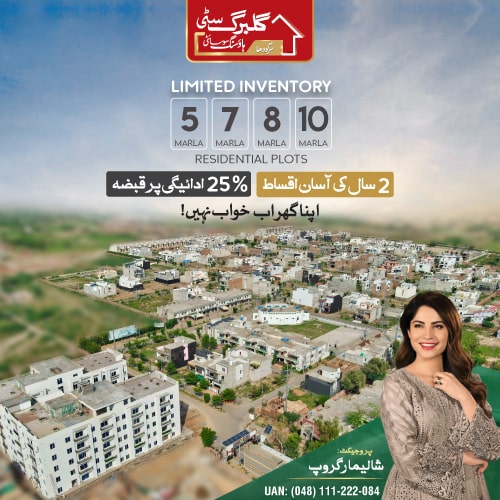
Mixed-use community commercial — grocery stores, tailors, utility shops, local services. These succeed on residential density alone. A well-planned housing society with 5,000+ residents and a properly designed commercial strip creates captive demand that sustains tenants for decades. Gulberg City Sargodha's operational commercial area works on exactly this principle — a dense, active residential community with genuine daily-use demand already present.
Smart city and business district commercial — the emerging category in Pakistan. Purpose-built business districts like Shalimar Smart City Sargodha's Smart Business District — with its Business Bay, Shopping Bay, food courts, and IT district — are engineered to attract commercial tenants by design, combining footfall from residents, professionals, and destination visitors in one planned ecosystem. Entry into these at early-phase pricing captures the appreciation curve before demand is fully established.
Know your demand type before you choose your site. The location criteria follow from there.
The Five Location Signals That Predict Commercial Success
Once you've identified your demand type, evaluate every potential commercial site against these five signals:
1. Residential density within 1 km The single strongest predictor of retail and community commercial success is how many households can reach the property on foot or within a 5-minute drive. Use school enrolments, mosque congregation size, and visible housing density as proxies when formal data isn't available. A commercial unit serving 3,000 households will outperform one serving 500 — every time.
2. Traffic volume and flow direction Count the vehicles. Watch the pedestrians. Do people pass this location on their way to somewhere, or is it a destination they'd specifically travel to? Passing traffic generates impulse demand — the backbone of retail. A shop on the route between a residential area and a main market generates far more organic footfall than one tucked in a cul-de-sac.
3. Anchor tenants and commercial neighbours Successful commercial zones cluster. A pharmacy next to a clinic. A stationery shop near a school. A food street where the first restaurant's success draws the second and third. When evaluating a commercial location, ask: what established businesses are already succeeding nearby? Proximity to strong anchor tenants — a supermarket, a bank, a well-known brand — imports their footfall to your unit.
4. Access, parking, and road width In Pakistan's urban environment, this is frequently underestimated. A commercially zoned property on a 20-foot road where parking is impossible is functionally inaccessible for most businesses. Wide internal roads, designated parking, and ease of access from major arteries directly determine tenant quality and rental achievability. Shalimar Smart City's 150-foot Main Boulevard and 40–70 foot internal streets are not just aesthetic choices — they're commercial infrastructure that makes the entire Business District viable.
5. Future development trajectory Commercial locations appreciate as their surroundings develop. A unit purchased when the surrounding area is 30% occupied and priced accordingly will be worth significantly more when occupancy reaches 80%. Read the development pipeline: what is being built nearby, what infrastructure is planned, and what phase of the development curve the location currently sits at. Early entry into a rising commercial zone compounds far more powerfully than buying into an already-established market.
Legal and Zoning Checks Non-Negotiable for Commercial Property
A commercially excellent location means nothing if the legal foundation is wrong.
Verify commercial zoning — Confirm the plot or unit is officially designated commercial by LDA, SDA, DHA, or the relevant authority. Residential land being used commercially carries serious legal risk and can be shut down Check NOC and building plan approvals — Ensure the developer holds valid approvals for commercial construction. Request the NOC number and verify it directly with the issuing authority Confirm utility connections — Commercial operations require reliable electricity, gas, and water. Verify connection status before committing, not after Review tenant restrictions — Some societies restrict certain commercial categories (food businesses, certain retail types). Know what can and cannot operate from your unit before you buyThe Commercial Location Checklist
Before finalising any commercial property decision:
Residential density within 1 km — enough to sustain demand? Daily passing traffic — pedestrian and vehicular? Established anchor tenants nearby? Road width and parking adequate for intended use? Commercial zoning officially confirmed with issuing authority? NOC and building plan approvals verified? Development trajectory — is this area growing or stagnant? Utility connections confirmed and operational? Full cost breakdown in writing — purchase price, transfer fee, society charges, maintenance? Developer track record on previous commercial projects verified?Final Takeaway
The perfect commercial location in Pakistan isn't the one with the lowest price or the most impressive brochure. It's the one where demand already exists or is structurally guaranteed to arrive — where residents, traffic, infrastructure, and design combine to make commercial success not just possible but probable.
Choose the location first. Let everything else follow from there.
Which commercial area in Pakistan do you think is the most undervalued right now — and why? Drop your take in the comments.
Find verified commercial listings across Pakistan's top commercial zones on Jaageer.com — from established city centres to the smartest new developments.