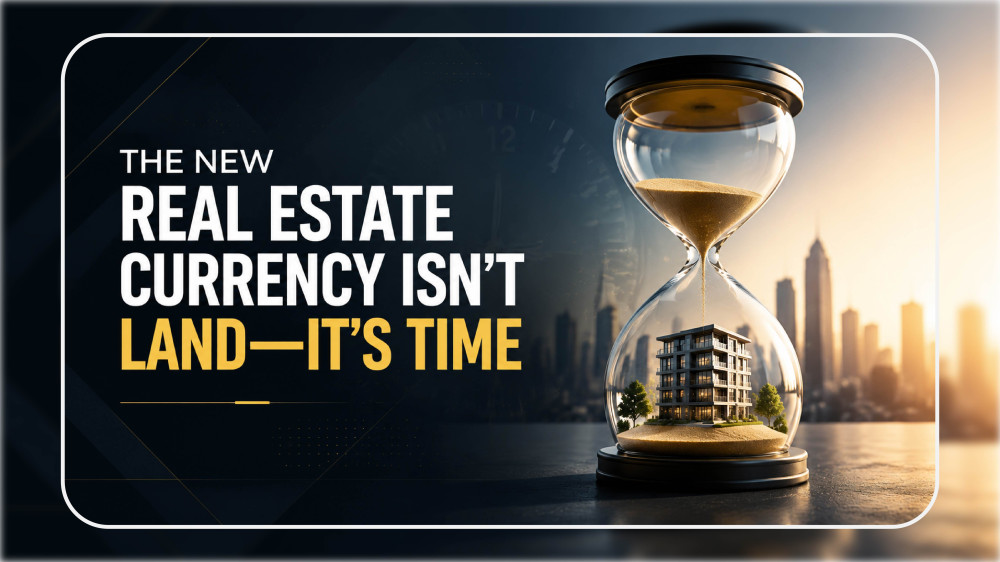
The New Real Estate Currency Isn't Land — It's Time
Here's a question nobody asks before buying property in Pakistan: how many hours of your life will this address cost you every year?
Not the price per square foot. Not the plot size. Not even the neighbourhood name. The hours — spent stuck in traffic, driving children to school, running to a pharmacy at night, or commuting to work through city gridlock that gets worse every single year.
Land has always been the traditional measure of property value. But something is shifting. Quietly, then all at once, time is becoming the real currency of real estate — and the buyers who understand this first are making the smartest investments of their lives.
The Hidden Cost Nobody Calculates
Let's put a number on it.
The average Pakistani professional in a major city spends 1.5 to 2.5 hours commuting daily. Over a working year, that's roughly 400 to 600 hours — or 16 to 25 full days — sitting in a car, burning petrol, and arriving somewhere stressed.
Now ask: what if your home address cut that in half?
That's not just a lifestyle upgrade. It's a financial calculation. Less fuel. Less vehicle wear. Less paid childcare to cover the hours you lose. Less stress, which directly affects productivity and health. And increasingly, it's a calculation that Pakistani buyers are making consciously when they choose where to live.
The result? Properties that return time to their residents are commanding premiums that pure land size simply can't justify anymore.
Why Pakistan's Property Market Is Feeling This Shift Right Now
Three forces are accelerating this trend simultaneously:
1. Traffic has become genuinely unbearable. Lahore, Karachi, and Islamabad regularly feature in global congestion indices. A journey that took 20 minutes a decade ago can take 50 minutes today. Buyers who once accepted a long commute because it meant a bigger plot are rethinking that trade-off.
2. Fuel costs have made car dependence expensive. When petrol prices spike — and in Pakistan, they spike often — every kilometre between your home and daily life has a direct rupee cost. A well-located property doesn't just save time. It saves thousands of rupees a month.
3. Remote and hybrid work has changed what people need nearby. When office commutes became optional for many professionals, the question shifted from "how far is it from my office?" to "how close is it to everything else?" Schools, hospitals, cafés, grocery stores, gyms — daily life infrastructure now matters more than proximity to a single CBD.
What "Time-Rich" Property Actually Looks Like
Not every property that markets itself as "conveniently located" is genuinely time-rich. Here's what to look for:
On-site or walking-distance essentials
A housing society with a school, pharmacy, grocery store, and café inside or within five minutes on foot saves hours every week — compounded across years of living there. That's not a luxury feature. It's a time asset built into the price.
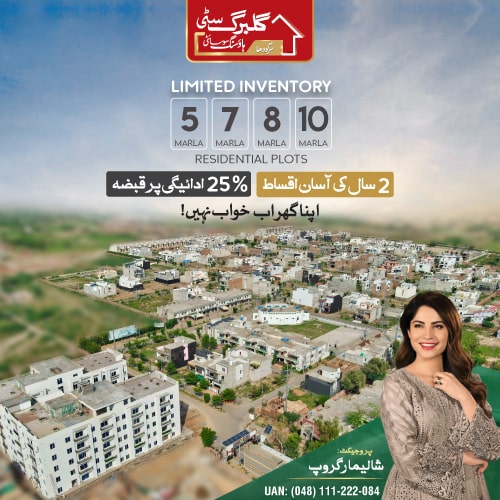
Gulberg City Sargodha is a strong example. Located just 1 km from IbneSina Hospital at Kanchi Morr, it already has a commercial area, parks, Grand Jamia Masjid, and Café De Lime on the ground — not as future promises, but as existing infrastructure. For a Sargodha resident, that means genuine time savings from day one of possession.
Mixed-use design
Developments that blend residential, commercial, and recreational zones within one master plan are inherently time-rich. Shalimar Smart City Sargodha was designed by Singapore-based Meinhardt with exactly this philosophy — a Smart Business District, Shopping Bay, food courts, school campus, and green spaces all within the project boundary. Residents don't just live there. They can work, shop, exercise, and socialise without a single car trip.
Road infrastructure that connects, not traps
Wide internal roads and good connections to city arteries determine whether a project's location advantage is real or theoretical. Shalimar Smart City's 150-foot Main Boulevard and 40–70 foot internal streets aren't just impressive on paper — they prevent the gridlock that turns "well-located" projects into daily frustrations.
The Investor's Angle: Time-Rich Properties Hold Value Harder
For investors, the time-currency shift has a direct impact on returns.
Rental demand for time-rich properties is stickier. Tenants who find a home that genuinely simplifies their daily life don't leave easily — finding a comparable property is hard. Lower vacancy rates mean more consistent rental income.
Resale premiums grow over time as congestion worsens. A property that saves 45 minutes a day becomes more valuable as the city around it gets slower. You're not just buying what the property is worth today — you're buying the appreciation that comes as urban life gets more complex around it.
Early entry into well-planned projects locks in the time premium before the market prices it in. Early investors in Shalimar Smart City Sargodha have already seen 40–50% capital gains — partly because buyers recognised that a Singapore-designed, mixed-use smart city addresses time-poverty in a way nothing else in the region does.
What to Ask Before You Buy
Shift your evaluation checklist from square footage to time value:
How long will my daily commute be from this address — honestly, in peak traffic? Can I reach a school, clinic, and grocery store within 10 minutes without a car? Does this development have on-ground amenities, or are they still "coming soon"? Will the internal road infrastructure support easy movement as the project grows? Is this area getting better-connected over time, or more congested?If a property scores well on all five, it isn't just a good home. It's a compounding time investment.
Final Takeaway
Pakistan's property buyers have spent generations measuring value in marlas and kanals. That still matters. But the buyers winning in 2025 are adding a new metric: minutes per day returned.
The best property isn't always the biggest plot. It's the one that gives you your life back — a little, every single day.
Which would you choose: a bigger house that adds an hour to your commute, or a smaller one that saves it? Tell us in the comments.
Find properties that work for your lifestyle — not just your budget — on Jaageer.com, Pakistan's trusted property portal.