Why Commercial Properties Create Long-Term Wealth in Pakistan
Most Pakistani investors follow the same path: buy a plot, construct a house, rent it out for PKR 25,000 a month, and call it an investment. It works — but it's rarely wealth-building in any meaningful sense. The monthly rent covers maintenance, taxes, and maybe a small surplus.
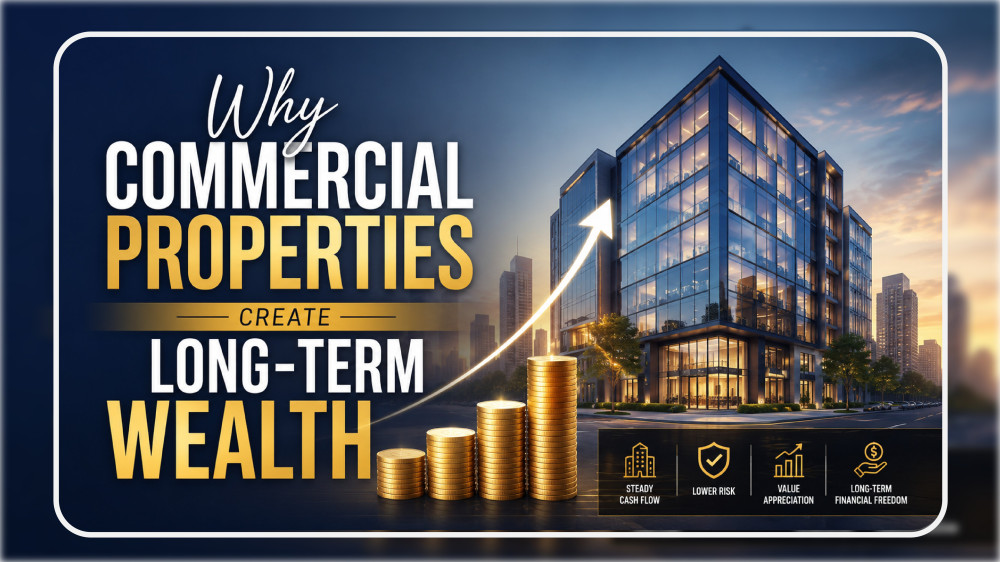
Here's what fewer people talk about: commercial property plays by entirely different rules. Higher yields, longer leases, lower vacancy headaches, and capital appreciation driven by business activity rather than just plot demand. For investors who want real, compounding wealth — not just a rental trickle — commercial property in Pakistan deserves serious attention.
The Yield Gap Nobody Talks About
The single biggest difference between residential and commercial property in Pakistan is the rental yield.
Residential rental yields in major Pakistani cities average 2–4% annually. A house worth PKR 2 crore rents for roughly PKR 35,000–50,000 a month. That's a 2.1–3% yield — often barely enough to cover maintenance, property tax, and the cost of periodic vacancy.
Commercial properties tell a different story. Well-located shops, offices, and mixed-use units can deliver 6–9% annual rental yields, sometimes higher in high-footfall commercial zones. The same PKR 2 crore invested in a commercial unit in an established area can generate PKR 10,000–15,000 per month more than its residential equivalent — every single month, compounding over years.
The math isn't complicated. The discipline to act on it is.
Longer Leases = More Predictable Wealth
Residential tenants in Pakistan typically rent month to month or on annual agreements. They move when prices rise elsewhere, when they buy their own property, or simply when they want a change. Vacancy periods of 2–4 months between tenants are normal — and those gaps eat directly into your annual return.
Commercial tenants operate differently. A business that has fitted out a shop, printed signage, and built a customer base at a location does not want to move. Commercial leases in Pakistan commonly run for 3–5 years, with built-in rent escalation clauses of 10–15% annually. Many renew multiple times.
This stability is wealth-building in a way residential rental income rarely is:
Predictable cash flow you can plan around Rent escalation that outpaces inflation over time Lower vacancy risk because relocation is expensive for the tenantThe longer the lease, the more predictable the income stream — and predictable income is the foundation of compounding wealth.
Capital Appreciation Driven by Business Activity
Residential property values track general demand — population growth, housing schemes, and market sentiment. Commercial property values track something more powerful: economic activity.
When a commercial zone matures — when footfall grows, businesses succeed, and an area becomes known as a destination — property values respond accordingly. MM Alam Road in Lahore, Blue Area in Islamabad, and Clifton's commercial strip in Karachi all followed this pattern. Early investors who bought commercial units in these areas before they reached peak activity made returns that dwarf anything residential property delivered in the same period.
The opportunity today lies in emerging commercial zones that are still in their growth phase. Shalimar Smart City Sargodha's Smart Business District is a textbook example — a purpose-designed commercial hub within a Singapore-planned smart city, currently being developed in a market (Sargodha) with a clear shortage of modern retail and office space. Early commercial investors have already seen 40–50% capital gains, with commercial units projecting a 7–9% rental yield as the Business Bay, Shopping Bay, and food courts come online. That combination — appreciation plus yield — is exactly what commercial wealth-building looks like.
What Types of Commercial Property Are Available in Pakistan?
Commercial property isn't one thing. Depending on your budget and risk appetite, here are the main categories:
Retail shops — Units in housing society commercial areas, marketplaces, or mixed-use developments. Lower entry point, high demand in established societies. Gulberg City Sargodha's commercial strip — already operational with businesses and foot traffic — is a strong example of a retail commercial investment with on-ground activity backing the yield.
Office floors and business centres — Suited to larger budgets. Blue Area Islamabad, Gulberg Lahore, and purpose-built office towers. Tenants are typically corporates, banks, or professional service firms on multi-year leases.
Mixed-use units — Ground floor commercial + upper floor residential or office. Best of both worlds. Common in new society developments and increasingly in smart city projects.
Warehouses and light industrial — Near ring roads, motorway interchanges, and industrial zones. Yields can be strong, leases long, and demand driven by e-commerce and logistics growth. Less glamorous but often very reliable.
What to Check Before Buying Commercial Property in Pakistan
Commercial due diligence is more detailed than residential. Get these right before you commit:
Zoning and commercial permission — Is the property officially designated commercial by the relevant authority? Residential plots being used commercially have no legal standing and can be shut down. Footfall and access — How do customers or tenants reach this property? Parking, road width, and visibility matter enormously for retail. Existing or potential tenancy — Is there a tenant already in place? What are the lease terms? A tenanted commercial property with 3 years remaining on a lease is worth significantly more than an empty unit. Developer track record — For commercial units in housing societies or smart cities, verify what the developer has previously delivered and whether commercial areas in their previous projects are actually active. Phase and completion status — A commercial unit in a fully developed, occupied project is very different from one in a project that's 40% developed. Price the risk accordingly. Full cost breakdown — Commercial property has additional costs: registration, transfer fees, society maintenance charges, and sometimes parking levies. Get all of it in writing before you sign.Final Takeaway
Residential property keeps many Pakistani investors comfortable. Commercial property is what builds real, generational wealth — through higher yields, longer leases, rent escalation, and capital appreciation tied to genuine economic activity.
The investors making the most money in Pakistan's real estate market right now aren't chasing residential plots in peripheral housing schemes. They're buying commercial units in zones where businesses want to be — and holding them long enough for the compounding to do its work.
Are you currently invested in commercial property in Pakistan — and if not, what's holding you back? Share your thoughts in the comments.
Whether you're looking for your first commercial unit or expanding a portfolio — explore verified commercial listings across Pakistan on Jaageer.com, Pakistan's trusted property portal.